NOTES ON THE PRACTICAL PHILOSOPHY OF THE EARLY 20TH CENTURY
DOI:
https://doi.org/10.5216/phi.v17i1.16894Keywords:
Spirit, concrete, universal, particular.Abstract
We shall place ourselves beside Merleau-Ponty’s philosophy to shed light on the notion of concrete, which brings in it the fact and the essence, the particle and the universal, in doing so we shall be opposed to the theoretical attitude, named by Merleau-Ponty “small rationalism”, of the early twentieth century. Firstly, we shall remember how the philosopher characterizes the theoretical attitude that reduces everything that can be said about the world to the scientific. After, we shall briefly insist upon the fact that this theoretical attitude is not far from a highly naïf political attitude which is unaware of the world it belongs to. According to Merleau-Ponty, in order to understanding the rapports between the sense and the non-sense it is necessary a new conception of reason: not a reason which operates by concepts on the background of an unquestionable rationality, but a reason that considers its origins.Downloads
Download data is not yet available.
Downloads
Published
2012-09-15
Issue
Section
Dossiê de Artigos Originais
License
Authors who publish in this journal agree to the following terms:
- Authors retain copyright and grant the journal right of first publication, with the work simultaneously licensed under a Creative Commons Attribution License that allows others to share the work with an acknowledgement of the work's authorship and initial publication in this journal.
- Authors are authorized to enter into separate, additional contractual arrangements for the non-exclusive distribution of the journal's published version of the work (e.g., publishing in an institutional repository or as a book chapter), with an acknowledgement of its authorship and initial publication in this journal.
How to Cite
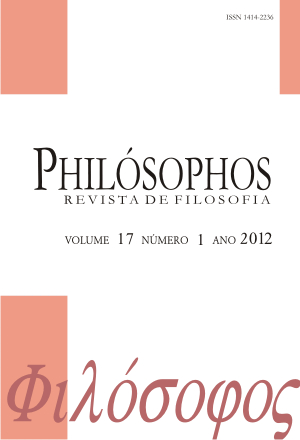
CARDIM, L. N. NOTES ON THE PRACTICAL PHILOSOPHY OF THE EARLY 20TH CENTURY. Philósophos a journal of philosophy, v. 17, n. 1, p. 87–107, 15 Sep.2012.